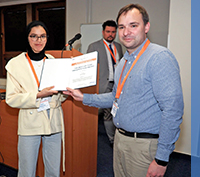

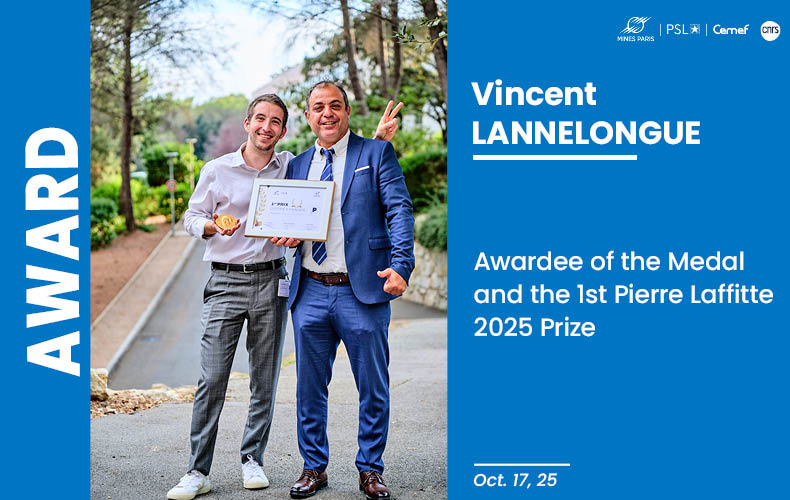
Vincent Lannelongue, awardee of the Pierre Laffitte 1st Prize & medal
Twelve finalists in their second year of doctoral studies gathered for the Pierre Laffitte Prize final on October 17.
Over the course of a full day, they gave oral presentations on their research with a specific goal in mind: to demonstrate the scientific value of their thesis, coupled with the innovation and advances it brings to industry and society as a whole. They did so before a jury composed of researchers and industry figures who take this mission very seriously.
The exercise is not the easiest: it requires the ability to synthesize and simplify complex work in order to extract its significance for society. They must convince the jury of the value of their work in 15 minutes. The jury does not hesitate to ask unusual and tricky questions.
Vincent Lannelongue received the Pierre Laffitte medal and the associated first prize for his exceptional presentation on “high-fidelity simulation and graph neural networks, supporting real-time decision-making for personalized treatment of intracranial aneurysms.”
Vincent is completing his PhD in the CFL team, under the supervision of Elie Hachem, leader of the ERC CURE project.
To help doctors diagnose and treat cerebral aneurysms, I am developing artificial intelligence tools capable of quickly predicting blood flow in the arteries of the brain. With the ERC team, we have trained and validated a model capable of simulating the behavior.
Presenting my work to a jury of professionals from fields very different from my own was an experience that was both stimulating and enriching! The goal of my thesis, like the entire ERC project, is to design a tool that will one day be used by doctors. Receiving this award gives even more meaning to this ambition—it is a real source of pride. The funds will support future academic exchanges for Paul, Ugo, and me as part of our doctoral research.
The second and third prizes were awarded respectively to Rafael Silva, Inria, for “Frugal AI for automated cardiac defibrillation in real time and with limited resources” and to Amar Meddahi, Centre O.I.E. MINES Paris – PSL, for his project: “Data and image fusion for solar forecasting applications.”
Congratulations also to Léa Guérandelle, a doctoral student in the CSM team, for her remarkable presentation on the biomimetic design of patient-specific dental restorations. This edition revealed a great deal of talent.
The Pierre Laffitte Award ceremony was a resounding success! It was a highlight to celebrate innovation and reward the best talent in our ecosystem! This award highlights the importance of collaborative research for the development of innovative solutions to the major challenges facing our society and is supported by the Sophia Antipolis Foundation.
Congratulations to all the winners!
The Pierre Laffitte Prize and Medal:
The Pierre Laffitte Prize, created by Elie Hachem, rewards second-year doctoral students who, through their research, propose innovative solutions for industry and society. After selection based on their applications, the finalists present their work and the resulting advances for the common good in an oral presentation before a jury. Three prizes are awarded each year. The first prize also receives the eponymous Medal.
This distinction is intended as a tribute to Pierre Laffitte, an extraordinary figure who was director of the École des Mines de Paris, creator of the concept of partnership-based research for industry, and founder of the Sophia Antipolis technology park.
Photo: Romain Castellani, CEMEF
Découvrir les autres actualités liées