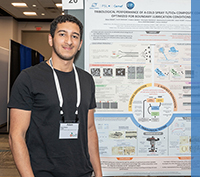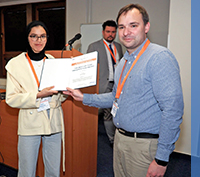

PhD defence of Wael Bader
On randomized linear algebra methods for solving large scale linear systems in computational mechanics

Wael Bader have conducted his doctoral research in the CFL team under the supervision of Youssef Mesri, in framework of a project with SAFRAN. He will defend his PhD in Computational Mathematics, High Performance Computing and Data on Dec. 17, 2025 in the front of the following jury:
– Anthony Nouy, Ecole Centrale de Nantes
– Alfredo Buttari, IRIT
– Laura Grigori, EPFL
– Pierre Gosselet, LAMCUBE
– Hatem Ltaief, KAUST
– Sebastien Da Veiga, ENSAI – CREST
– Augustin Parret-Fréaud, Safran Tech
– Youssef Mesri, Mines Paris – PSL
Abstract:
This thesis explores the use of Randomized Numerical Linear Algebra (RNLA) to accelerate large-scale simulations in computational mechanics. Building on a thorough study of RNLA theory, particularly randomized range finding and adaptive sampling for matrix approximation, we design new randomized algorithms that replace classical orthogonal projections with triangular structures, enabling efficient construction of LU- and Cholesky-type factorizations. We further develop adaptive randomized eigendecomposition and preconditioning strategies based on Nystrm and low-rank approximations,
culminating in two-layer adaptive randomized preconditioners tailored to ill-conditioned systems. The proposed methods are validated through extensive numerical experiments, combining synthetic benchmarks to assess accuracy, rank adaptivity, and convergence with industrial-scale test cases, including large mesh deformation problems using radial basis functions. Across all scenarios, the randomized solvers significantly reduce computational cost and memory usage while preserving accuracy comparable to deterministic methods, even under strong compression, and their implementation is supported by a dedicated Python framework for rapid prototyping and industrial integration.
Keywords: Randomized Numerical Linear Algebra, Low-rank approximation, Randomized Nystrm approximation, Randomized Preconditioning, Adaptive Factorization
Découvrir les autres actualités liées