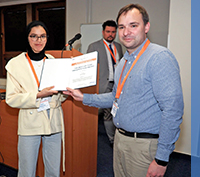

PhD defence of Pauline Hahn
Metallurgical evolution of Zr-Nb alloys during hot deformation processes: mechanisms understanding and simulations

Pauline Hahn conducted her doctoral studies in the MSR team under the supervision of Marc Bernacki, Baptiste Flipon and Madeleine Bignon in the framework of a CIFRE project with Framatome. She will defend her PhD in Computational Mechanics and Materials – under the agreement of the two reviewers – on Jan. 7, 2026 on:
Metallurgical evolution of Zr-Nb alloys during hot deformation processes: mechanisms understanding and simulations
in front of the following jury:
– M. BERNARD Frédéric
– Mme DUMONT Myriam
– M. LOGE Roland
– Mme TOFFOLON-MASCLET Caroline
– M. FLIPON Baptiste
– Mme BIGNON Madeleine
– M. BERNACKI Marc
– M. GAILLAC Alexis
– M. GRAND Victor
Abstract:
Zirconium alloys are mainly used in the atomic energy domain. Considering their neutron transparency, their mechanical properties and their corrosion resistance, these alloys are the material of choice for the manufacture of fuel assemblies located in the core of a nuclear reactor. To garantee a compliant and high-quality product, a complex manufacturing process involving a succession of different deformation and heat-treatment stages is required. Each step shapes the product for the next step in order to obtain a final product with the right dimensions. Microstructure evolution must also be controlled and mastered during the manufacturing process. Indeed, the microstructure provides most of the macroscopic properties of the alloy as well as the alloying elements. A better understanding of the underlying metallurgical mechanisms and the development of suitable simulation tools are therefore essential to develop safer components in line with increasing industrial and societal requirements in the nuclear field.
In this context, the objective of this PhD is to understand the microstructural evolution mechanisms present in Zr-1Nb alloy during thermomechanical treatments such as recrystallization and grain growth phenomena. First, grain growth kinetics are studied to highlight the influence of niobium content. Experimental charactrizations and full-field numerical simulations proved the solute drag effect of niobium and the impact of second-phase particules. Subsequently, several initial microstructures were considered to study dynamic and post-dynamic recrystallization phenomena. Thermomechanical tests are performed followed by experimental characterizations using EBSD, SEM, TEM, to demonstrate the particular features of these four microstructures and understand the different recrystallization kinetics observed. These kinetics are compared with numerical simulation results to validate the hypotheses put forward and obtain predictive simulations taking into account all the physical phenomena identified in the material.
Keywords: Zr-Nb alloys, Hot metal forming, Microstructure évolutions, Solute drag, Experimental characterizations, Full-field numerical simulations
Découvrir les autres actualités liées