
PhD defence of Marion Roth
Extension of a discontinuous dynamic recrystallization mean-field model to high strain rates on 316L steel
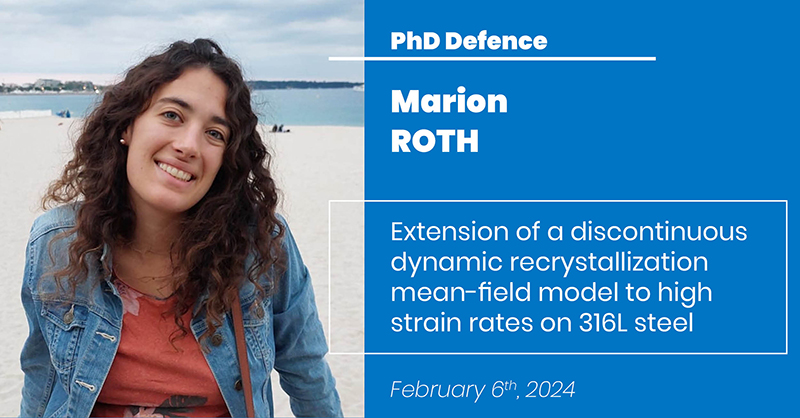
Marion Roth conducted her research work in the MSR team under the supervision of Marc Bernacki and Nathalie Bozzolo. She defends her PhD in “Computational Mechanics and Materials” specialty in front of the following jury:
– Laurent DELANNAY, UCL, Belgique
– Roland LOGE, EPFL, Suisse
– Frank MONTHEILLET, Mines Saint Etienne, Laboratoire Georges Friedel
– Julien FAVRE, Mines Saint Etienne, Laboratoire Georges Friedel
– Marc MORENO, Transvalor
– Nathalie BOZZOLO, Mines Paris – PSL, CEMEF
– Marc BERNACKI, Mines Paris – PSL, CEMEF
– Baptiste FLIPON, Mines Paris – PSL, CEMEF
– Aurélien HELSTROFFER, Framatome
– Emmanuel RIGAL, CEA, Liten
Abstract:
In order to obtain components with a specific geometry as dictated by the specifications, metallic alloys undergo various shaping stages. These successive stages typically involve mechanical deformations and heat treatments, significantly impacting the microstructure and contributing greatly to the mechanical properties of the finished product. It is of industrial interest to control these microstructural evolutions resulting from various phenomena such as grain growth, dynamic recrystallization, or post-dynamic recrystallization. To address this need, predictive models of microstructural evolution based on the physics of the involved phenomena have been developed. Two major families of microstructural evolution models exist in the literature: full-field models, where the microstructure is explicitly represented with intrinsic consideration of topology, and mean-field models, where the microstructure is implicitly represented. In the literature, these models may vary in the description of microstructures. Among these models, Maire et al. model proposes a hybrid approach, combining a topological approach in creating a specific neighborhood for each grain class with a statistical description of the microstructure based on a distribution of grain classes. This model has been proposed and validated for a limited range of deformation velocities (0,01 – 0,1 s-1). However, the deformation velocities commonly used in industrial processes often exceed these values.
In this context, the objectives of this thesis were to improve and validate this model for each of the mentioned phenomena and to propose a model valid over an extended range of deformation velocities from 0,01 s-1 to 500 s-1 for an austenitic stainless steel 316L. Experimental tests involving heat treatments and hot compressions were conducted. The microstructure resulting from these interrupted tests was analyzed using data obtained by SEM/EBSD. For each microstructural phenomenon present, the model was compared to experimental data as well as models from the literature. The limitations of the existing model formulation were identified, and modifications and additions were proposed. A new method associated with the description of nucleation was implemented and validated on different thermomechanical paths. This new method keeps the hybrid approach of topological neighborhood/statistical representation of the microstructure but enhances the description of dynamic recrystallization by considering the appearance of distributions of recrystallized grains in the microstructure. This model extension allows for better consideration of the experimentally observed dispersion in grain size distributions.
Keywords: Mean-field model, Grain growth, Discontinuous dynamic recrystallization, Topology, Nucleation, 316L
Découvrir les autres actualités liées