

PhD Defence of Benoît Wittmann
13 December 2020
Benoît Wittmann defends his PhD in Numerical Mechanics and Materials on Nov. 17th, 2020.
"Materials and processes of the micro and macro texturation of floor covering surfaces, optical and tribological properties"
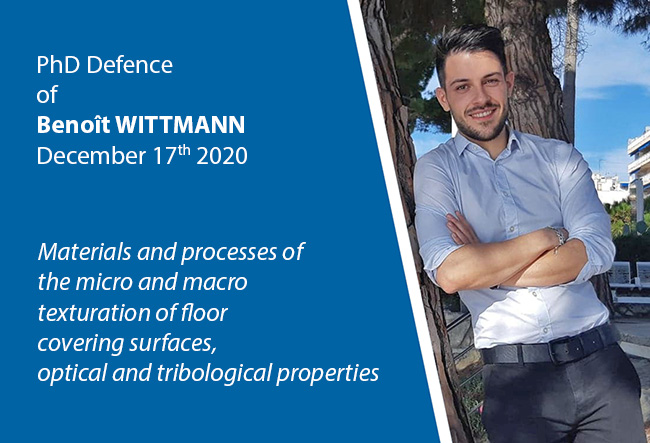
Benoît Wittmann conducted his thesis work in PSP team under the supervision of Pierre Montmitonnet, in the framework of a CIFRE project with Tarkett company.
He will defend his PhD work in Numerical Mechanics and Materials on Dec. 17th, 2020 in front of this jury:
– M.C. Gaël OBEIN (CNAM, Saint-Denis)
– Pr.U. Marie-Ange BUENO (Univ. de Haute Alsace-ENSISA, Mulhouse)
– D.R. Marie-Christine BAIETTO (INSA Lyon-Lamcos, Villeurbanne)
– Pr. Christian GAUTHIER (Univ. de Strasbourg, Strasbourg)
– Ing. Alain CASOLI (Tarkett Z.A. Salzbaach, Wiltz, Luxembourg)
– C.R. Alain BURR (MINES ParisTech-CEMEF, Sophia Antipolis)
– Pr. Jean-François AGASSANT (MINES ParisTech-CEMEF, Sophia Antipolis)
Abstract of his PhD work:
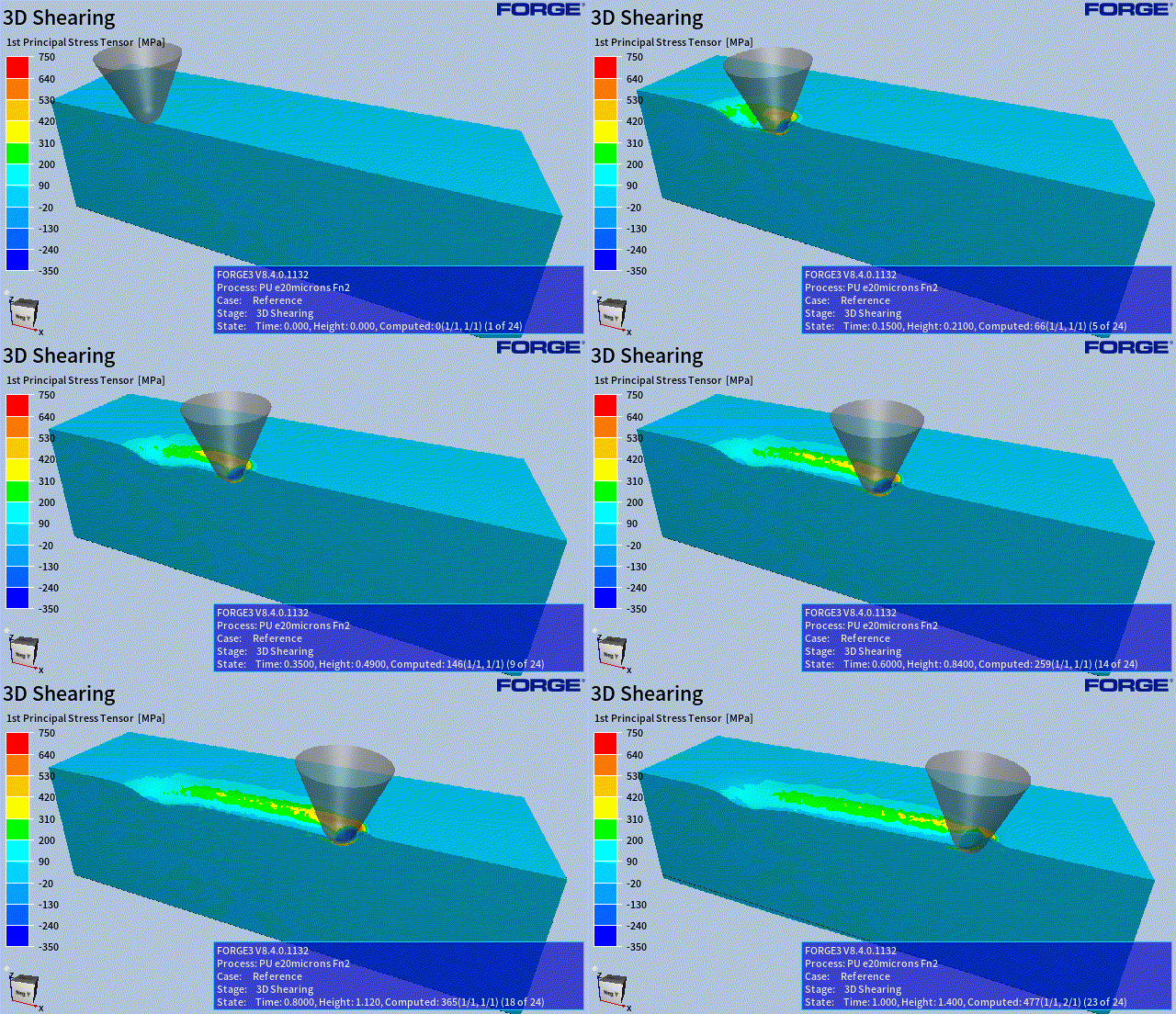
The visual aspect is a key problematic in the floor covering industry. In this thesis work, we are interested in its gloss and its time evolution with wear. First, a BRDF model (Bidirectional Reflectance Distribution Function) based on microfacets theory is developed. The novelty of this work is to compute the BRDF directly from the measured roughness of the sample. Secondly, we study the scratch resistance of the material, which is the main visually degrading damage mode. A method combining the in-situ vision of the tip/material contact, the characterization of the created cracks by tomography, and FEM simulations, allows to finely analyse the different phenomena observed experimentally. We are interested on the influence of the solicitation scale on the way the structure (coating over substrate) is deformed. Then, the scratch visibility, following the different deformation/fracture regimes observed, is studied by applying the BRDF model to the residual grooves. Finally, we propose different strategies to optimize the material by studying the influence of the substrate rheology, the coating rheology, and its thickness.
Keywords: Polymers, gloss, BRDF, tribology, scratch, tomography, FEM
Découvrir les autres actualités liées
Tribological Triplet of Boundary Lubrication: Influence of TiO₂ Nanoparticles, Composite Cold-Spray Coatings, and Electric Current on the Performance of Boundary Additives
Adam Nassif […]


Metallurgical evolution of Zr-Nb alloys during hot deformation processes: mechanisms understanding and simulations
Pauline Hahn conducted her doctoral studies in the MSR team under the […]
On randomized linear algebra methods for solving large scale linear systems in computational mechanics
Wael Bader have conducted his doctoral research in the CFL team under the supervision of […]
Wire laser additive manufacturing (WLAM): a multiphysics numerical simulation of heat transfer, fluid flow, and microstructure formation. Application to IN718 superalloy
Zichen Kong conducted […]
Hiba Bouras is in her third year of doctoral studies in the S&P team. She is conducting her research under the supervision of Tatiana Budtova, Yannick Tillier and Sytze Buwalda, as part of a […]

Multiphysics Track-Scale Simulation of L-PBF 316L Additive Manufacturing: Thermo-Fluid Flow, Grain Growth, and Crystal Viscoplasticity
Zixuan Li conducted his doctoral research in the 2MS team […]